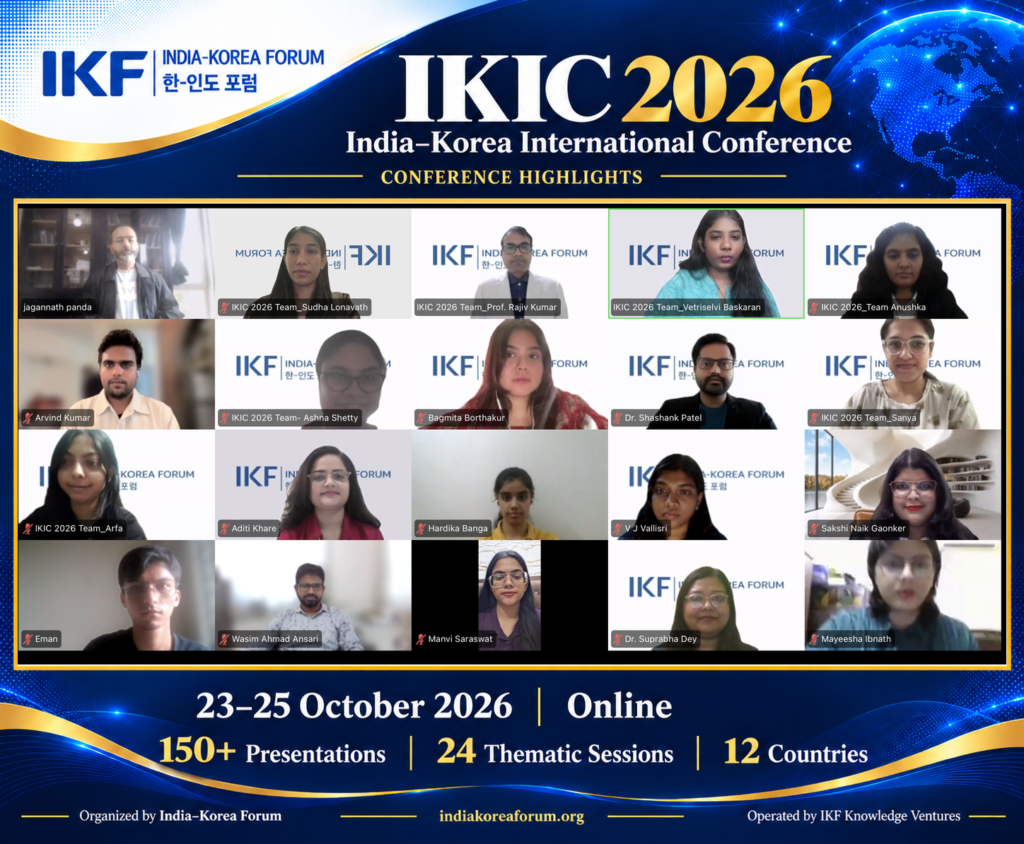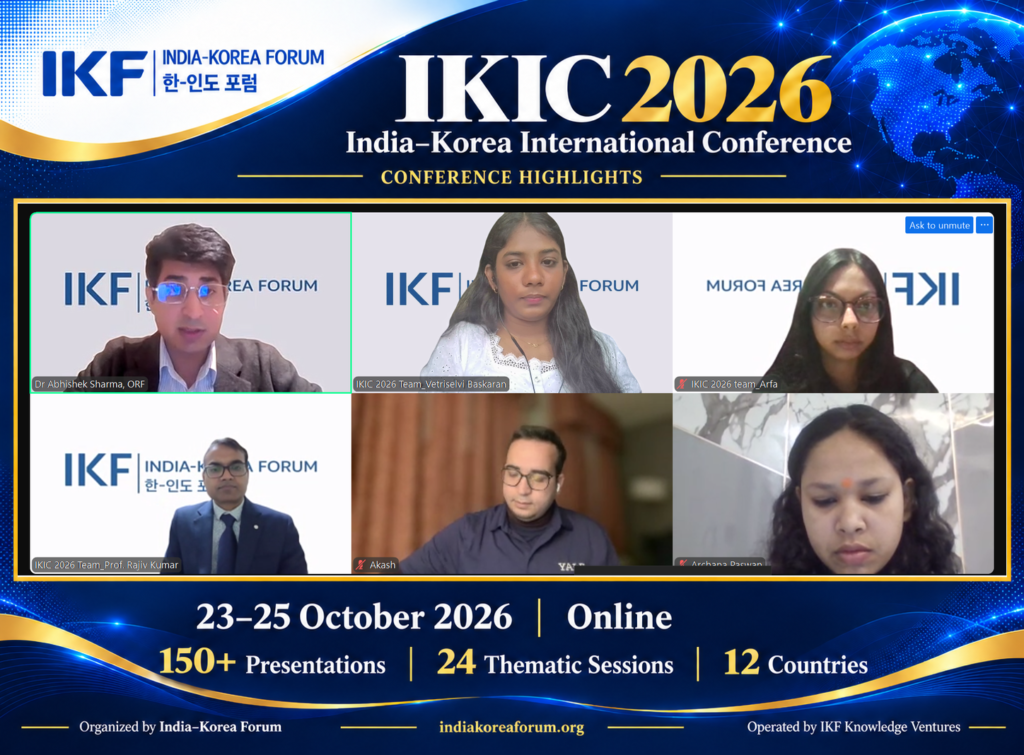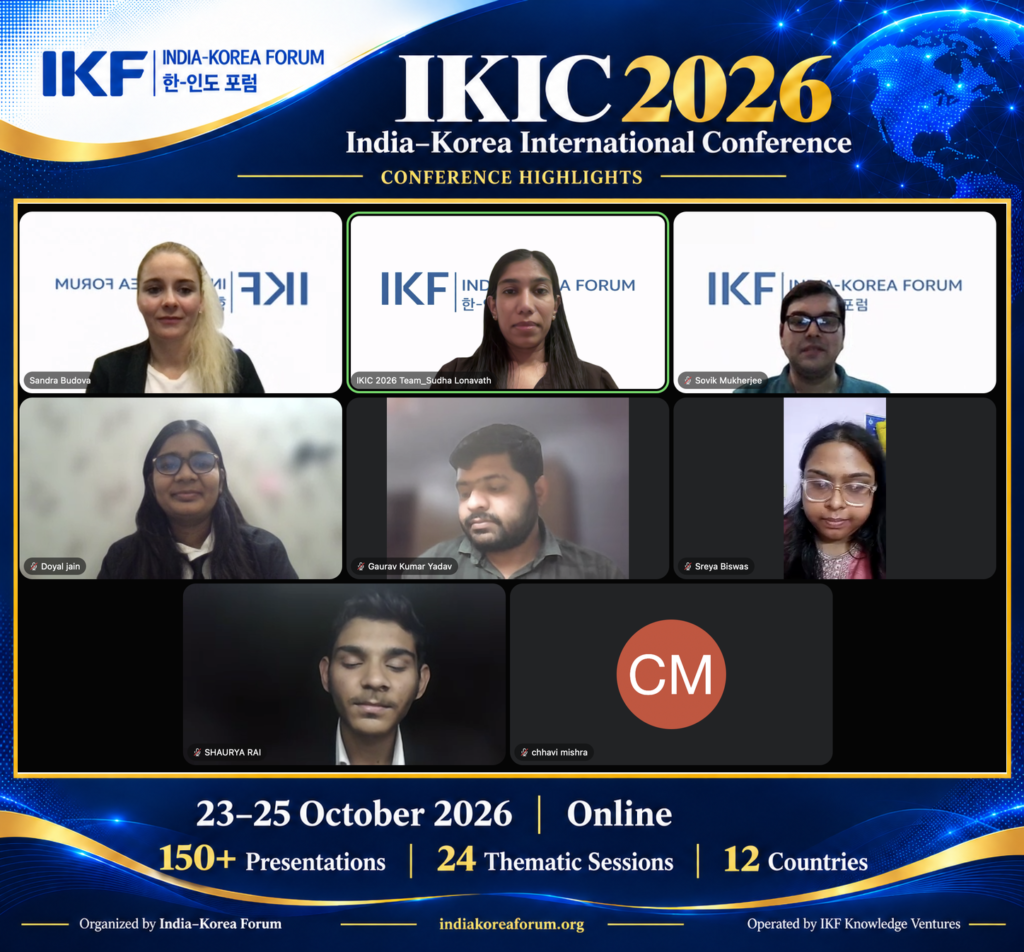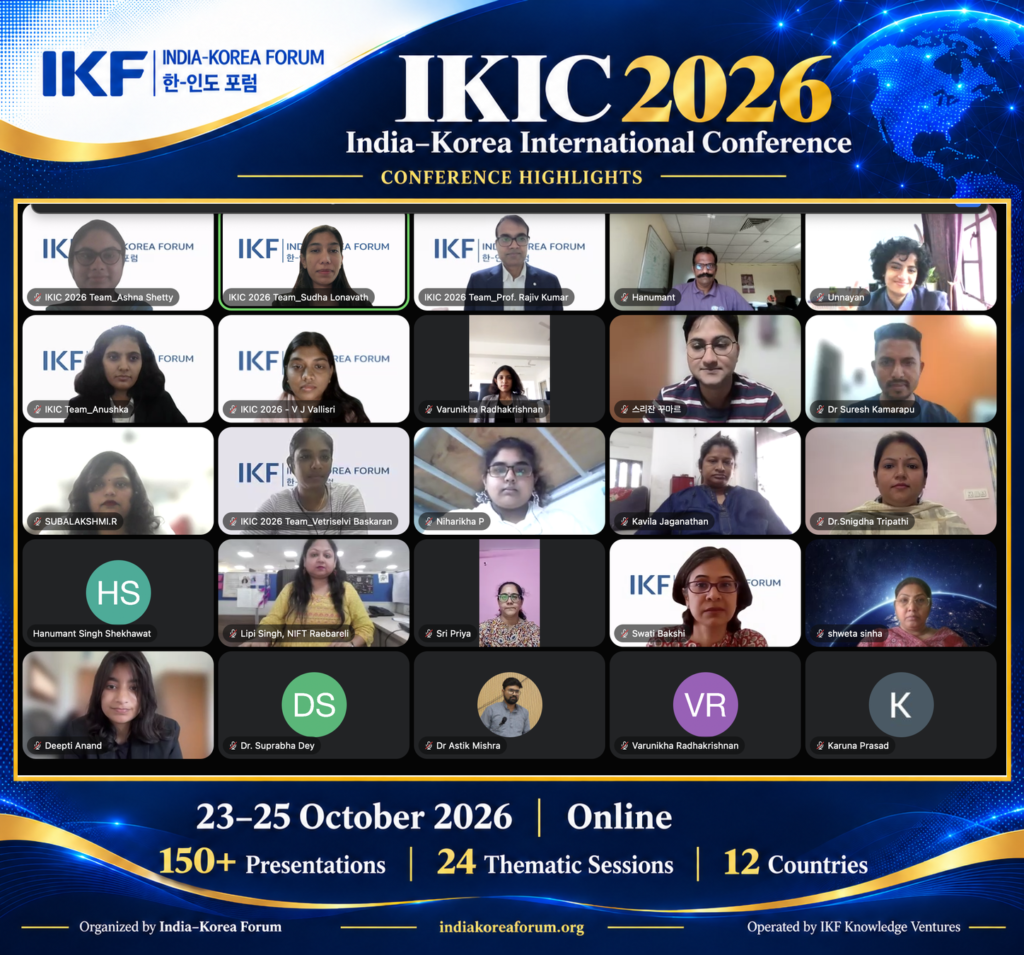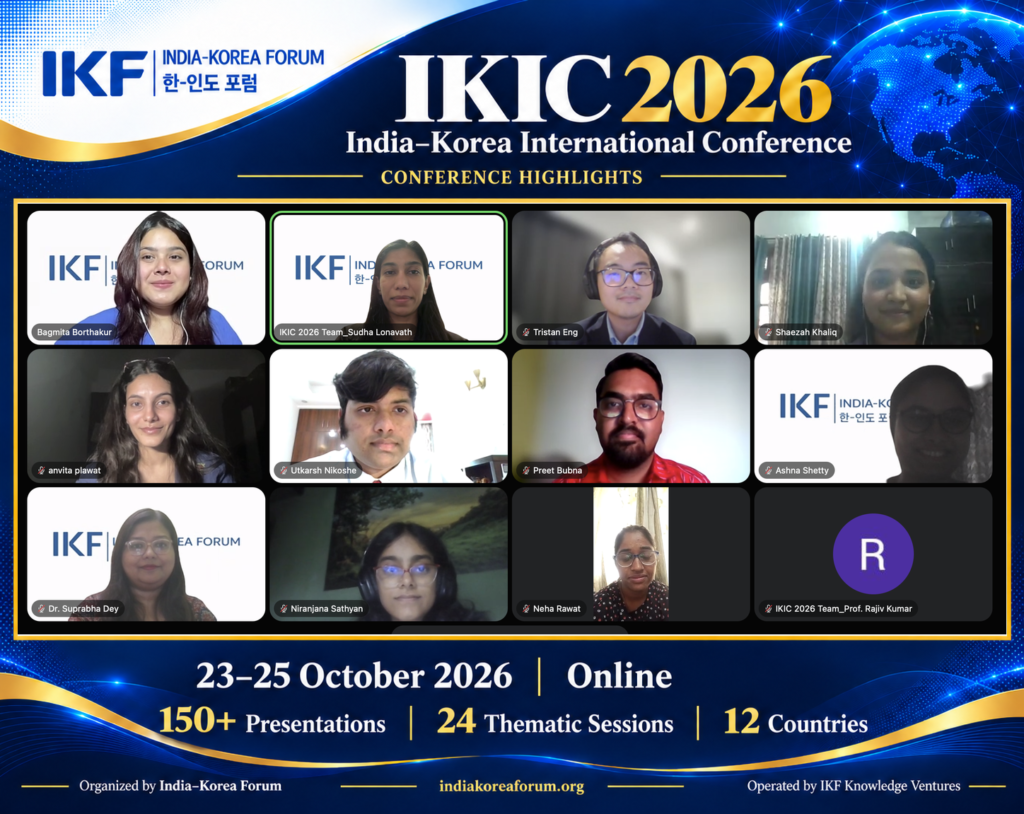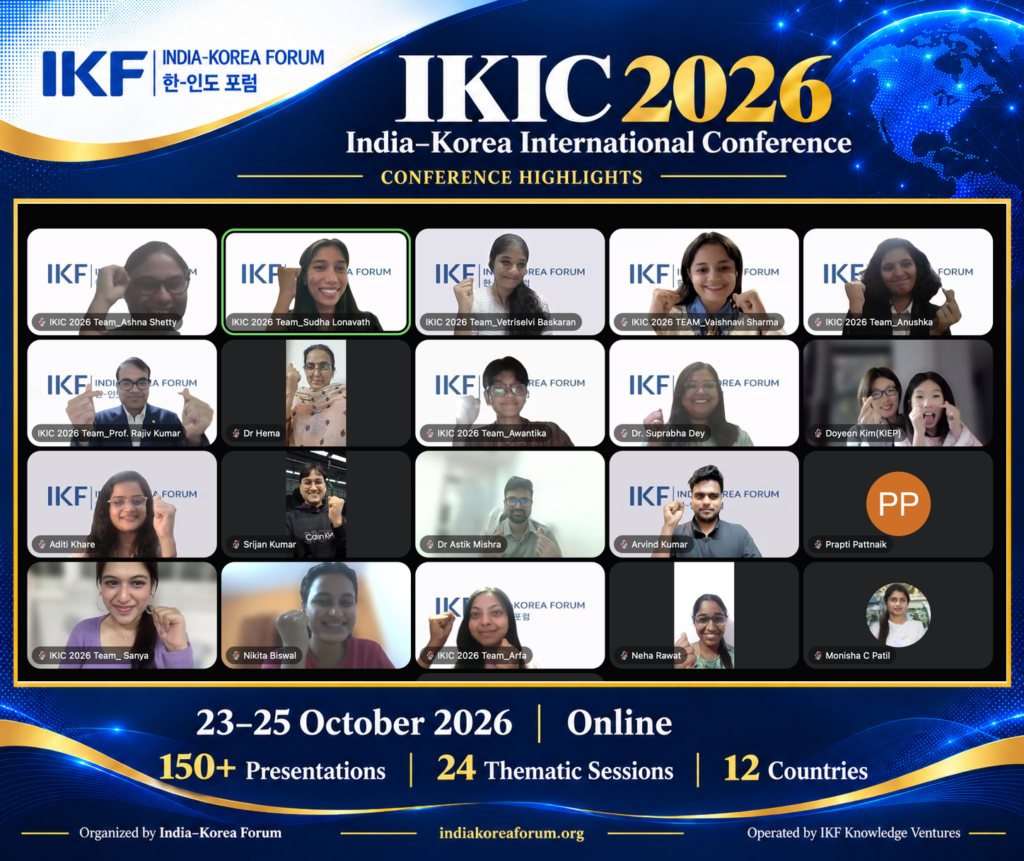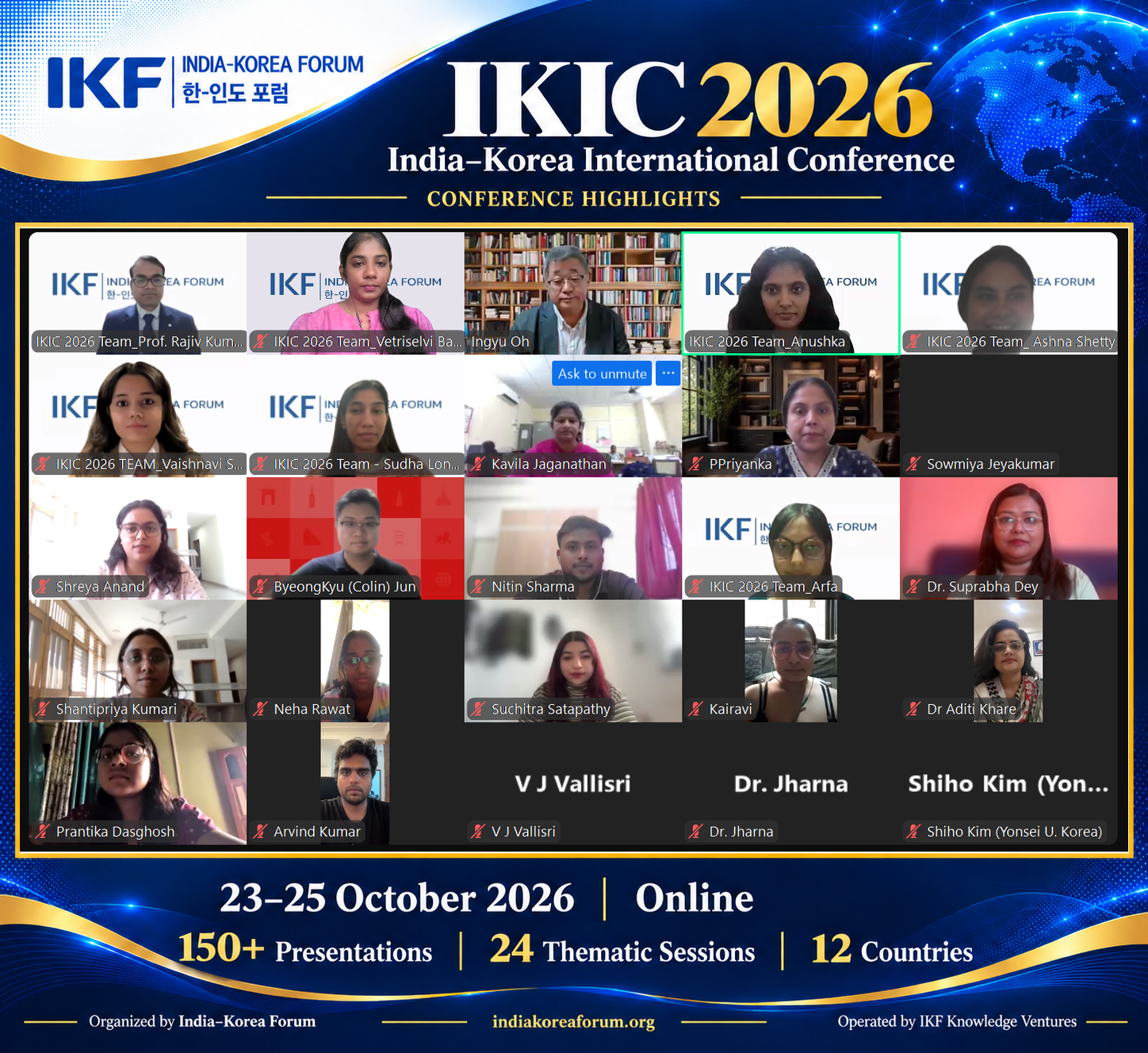
The three-day conference brought together participants from 12 countries and territories for 24 thematic sessions exploring technology, geopolitics, business, society, and culture.
The India–Korea Forum (IKF) successfully held the India–Korea International Conference 2026 (IKIC 2026) from 23 to 25 October 2026. Held online, the conference brought together scholars, researchers, academics, students, and professionals for an extensive programme of research presentations and expert discussions.
Under the theme “Emerging Technologies, New Geopolitics, and Societal Transformation: Building a Future-Oriented India–Korea Partnership,” IKIC 2026 featured more than 150 academic presentations across 24 thematic sessions, alongside a keynote address, five expert talks, a special book talk, and an industry insights presentation.
The programme connected developments in emerging technologies and international politics with questions of economic development, cultural exchange, and social change. Its interdisciplinary scope provided opportunities to examine India–Korea cooperation while placing bilateral relations within wider regional and global transformations.
Opening Ceremony and Keynote Address
The conference opened on 23 October with welcome remarks by Prof. Rajiv Kumar, Director of the India–Korea Forum and Organising Chair of IKIC 2026. Prof. Chanwahn Kim, Dean of the Graduate School of International and Area Studies at Hankuk University of Foreign Studies, delivered congratulatory remarks.
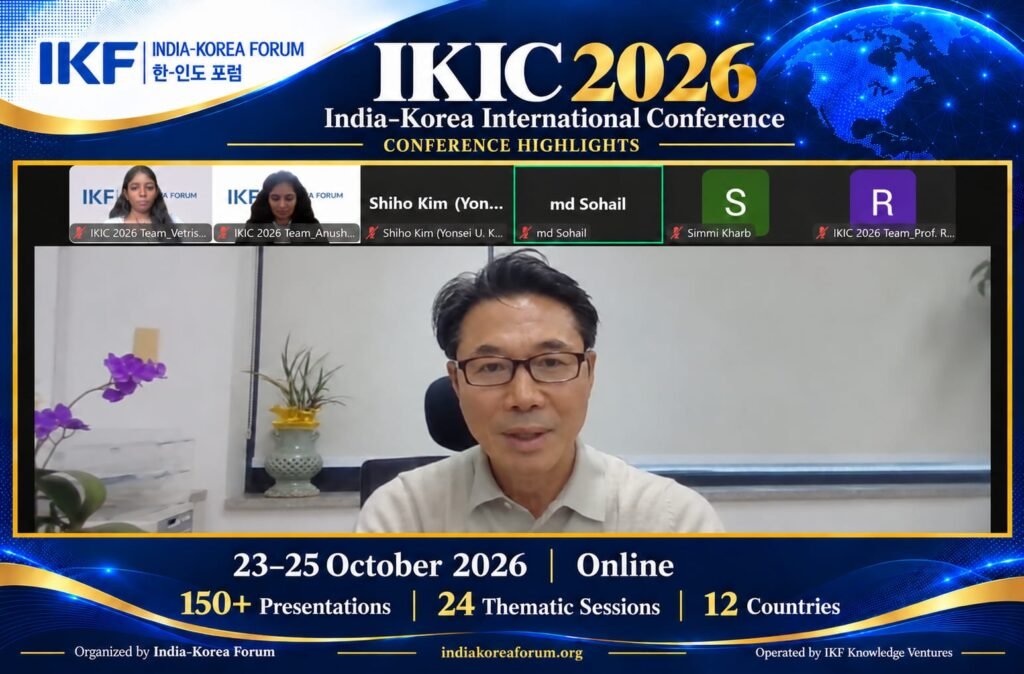
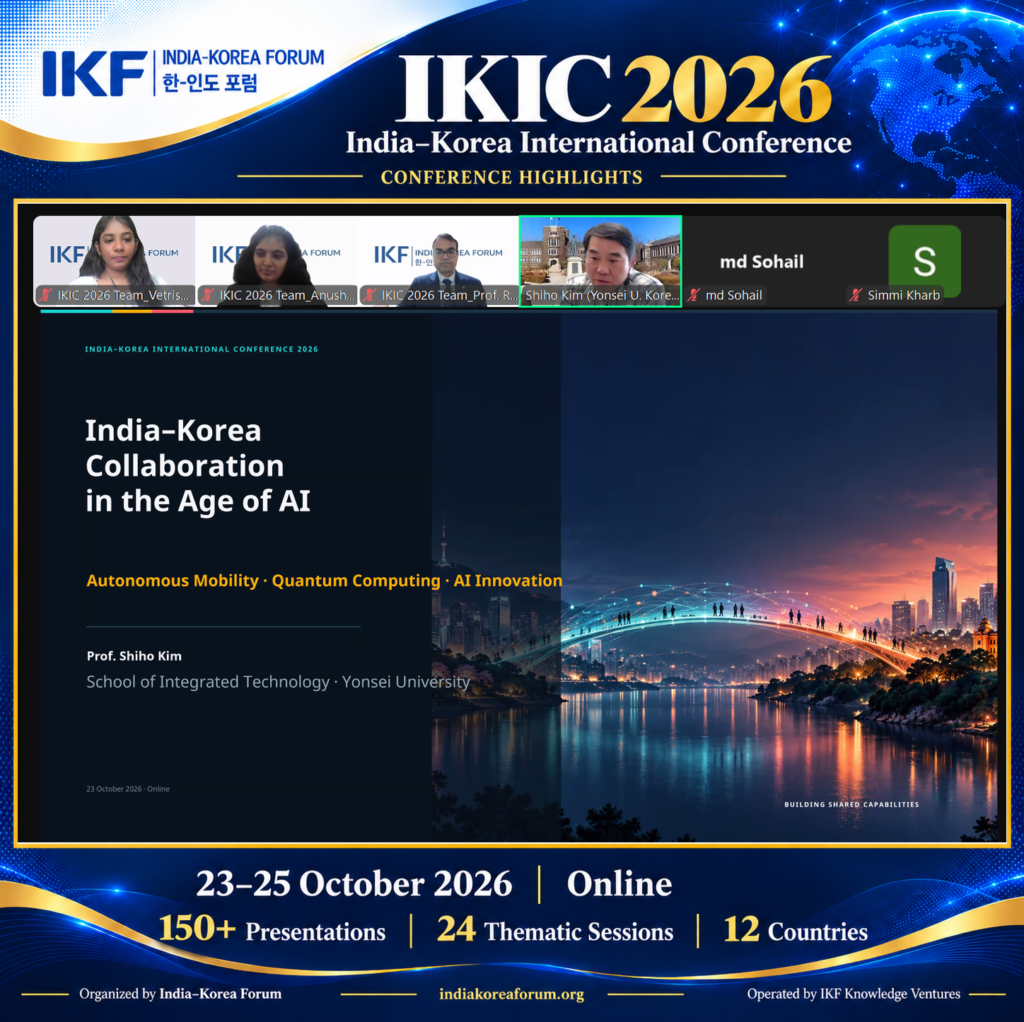
Prof. Shiho Kim of Yonsei University delivered the keynote address, “India–Korea Collaboration in the Age of AI: Autonomous Mobility, Quantum Computing, and AI Innovation.” His address placed advanced technologies at the forefront of the programme, highlighting an important field for future bilateral engagement.
Day 1 — Technology, Business, and Cultural Connections
The first day featured eight academic sessions, spanning semiconductor geopolitics, biomedical innovation, cinema, AI governance, historical connections, labour mobility, entrepreneurship, and consumer markets.
The session on “The Global Chip War” addressed geopolitics, supply chains, and prospects for India–Korea semiconductor cooperation. Other sessions explored the ethical and social implications of AI, Indian and Korean screen cultures, shared historical connections, and the changing relationship between work, skills, and mobility.
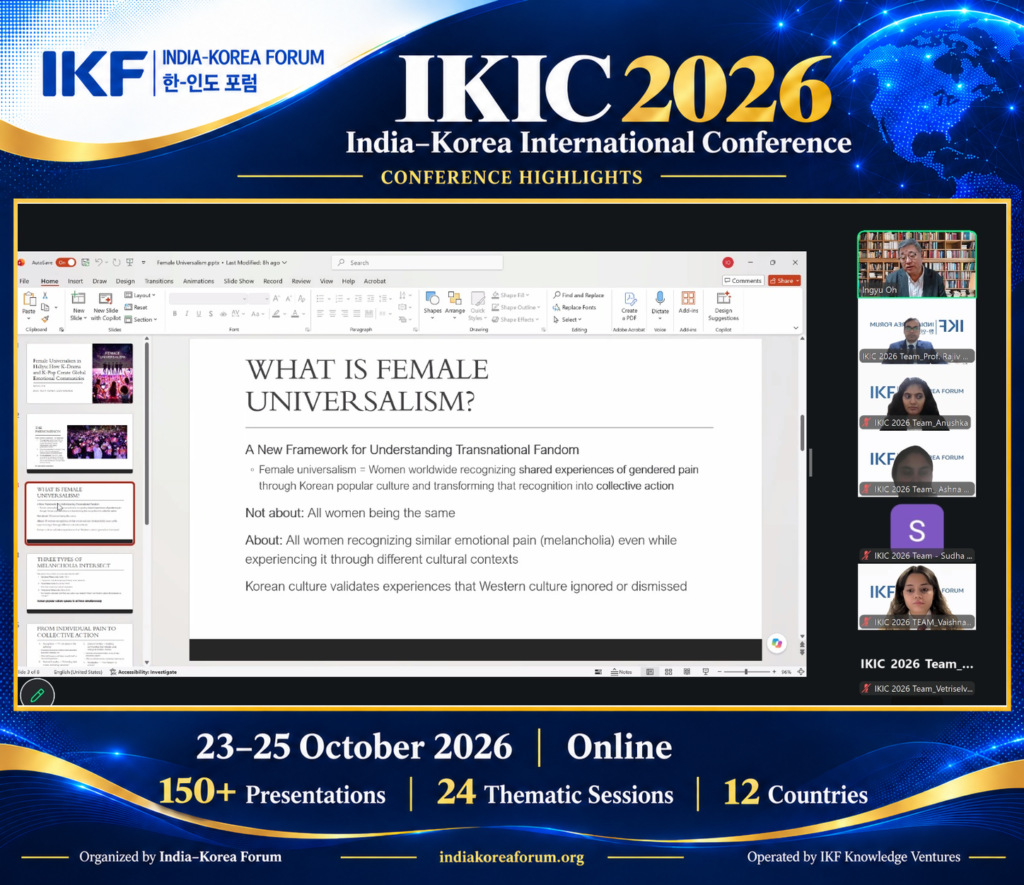
A special book talk by Prof. Ingyu Oh of Kansai Gaidai University, Japan, examined “Female Universalism in Hallyu: How K-Drama and K-Pop Create Global Emotional Communities.” The talk brought cultural production and international audiences into the conference’s discussion of contemporary transformation.
Mr. Vishnu Bhan of Aleph INDIA Group delivered an industry insights talk titled “From Technology to Trust: How Standards, Compliance and Quality Infrastructure Can Shape the Future of the India–Korea Partnership.” His contribution added a business perspective, drawing attention to the practical foundations of international cooperation.
Day 2 — Strategic Challenges and Societal Change
On 24 October, the conference continued with ten academic sessions examining advanced engineering and AI, gender and popular culture, critical minerals, democratic participation, Indo-Pacific security, trade, Hallyu, disaster resilience, cybersecurity, and cultural diplomacy.
Sessions on critical minerals and strategic supply chains and India–Korea trade, CEPA, and economic integration addressed issues central to contemporary economic cooperation. Discussions of China’s rise and strategic competition situated these questions within the changing Indo-Pacific environment.
The programme also explored the social dimensions of technological and cultural change, including feminist perspectives in popular culture, digital participation, public health vulnerabilities, and emerging digital threats.
Two expert talks complemented the sessions:
- Prof. Jagannath Panda, Institute for Security and Development Policy, Sweden — “India, Korea and the Digital Diary of Northeast Asia.”
- Ms. Doyeon Kim, Korea Institute for International Economic Policy (KIEP), South Korea — “India’s Renewable Energy Transformation: New Frontiers for Korea–India Cooperation.”
The day’s programme connected strategic and economic concerns with debates about governance, sustainability, and social well-being.
Day 3 — Education, Creative Industries, and Future Partnerships
The final day, 25 October, featured six academic sessions covering technology geopolitics, economic security, education, digital content creation, sustainable development, comparative literature, and Korean popular culture.
Presentations examined connections between digital content, the influencer economy, and creative industries, alongside opportunities for India–Korea cooperation in clean energy and inclusive development. Sessions on literature, folklore, and cultural narratives extended the comparative discussion, while presentations on Korean popular culture explored its relationship with social transformation and bilateral cultural exchange.
Three expert talks broadened the final day’s agenda:
- Prof. Hanumant Singh Shekhawat, Indian Institute of Technology Guwahati — “Modeling Human Emotions and Mental Health: Perspectives from India and South Korea.”
- Prof. Ivica Petrikova, Royal Holloway, University of London — “India’s Food Security Policies: Universalism, Commercialism, and Politicisation.”
- Prof. Rajiv Ranjan, University of Delhi — “Beyond the Westphalian Order: A Pluriversal Understanding of India–Korea Relations.”
The conference concluded with reflections by Prof. Rajiv Kumar, bringing the three-day programme to a close.
International Exchange Across Disciplines and Generations
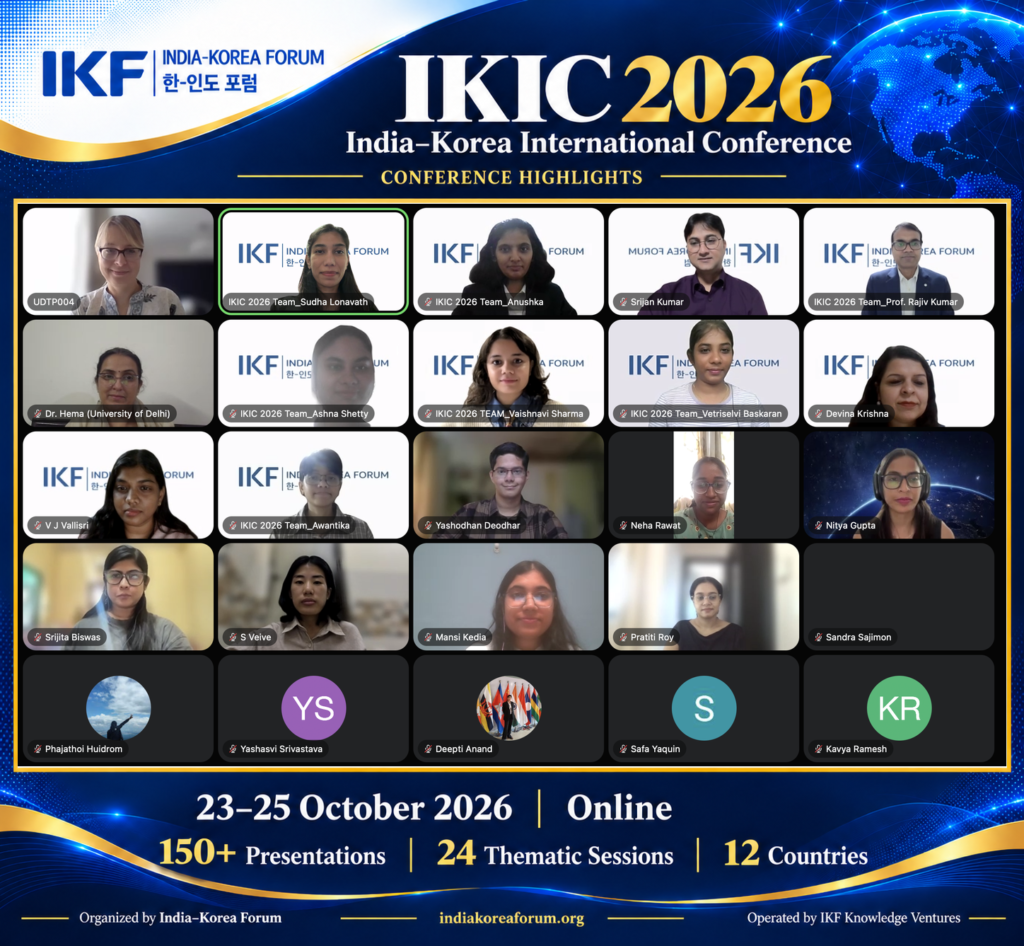
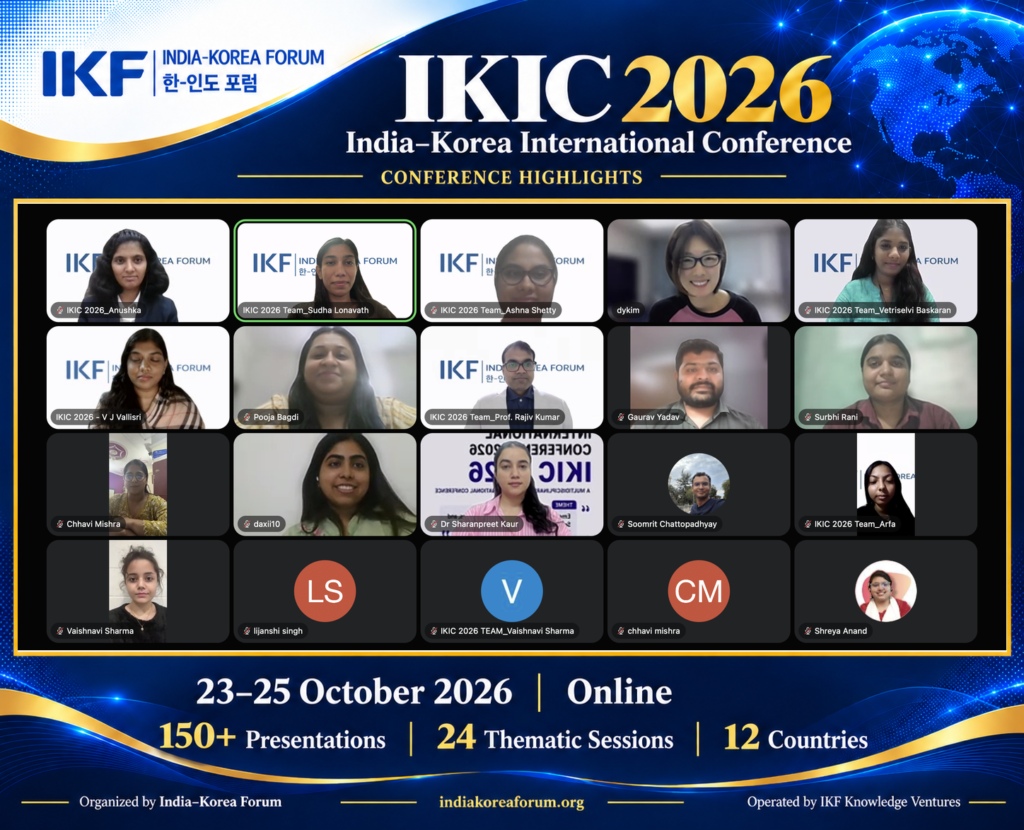
IKIC 2026 provided a platform for established academics, emerging researchers, students, and professionals to share research and engage with different perspectives. Questions and discussions following presentations created opportunities for scholarly feedback and further exchange.
Session chairs from universities, research institutions, professional communities, and the IKF NextGen Leadership Programme helped guide these conversations. The involvement of younger scholars alongside experienced researchers added an intergenerational dimension to the conference.
A defining feature of IKIC 2026 was the breadth of subjects brought into conversation. Discussions of semiconductor supply chains and economic security appeared alongside literature, education, public health, and popular culture, reflecting the interconnected forces shaping contemporary India–Korea relations.
The India–Korea Forum sincerely thanks all speakers, session chairs, presenters, participants, NextGen Fellows, and volunteers for their contributions to IKIC 2026.