



We are pleased to share that Prof. Rajiv Kumar, Director of the India–Korea Forum (IKF), has published a research article in The Journal of Asian Studies titled:
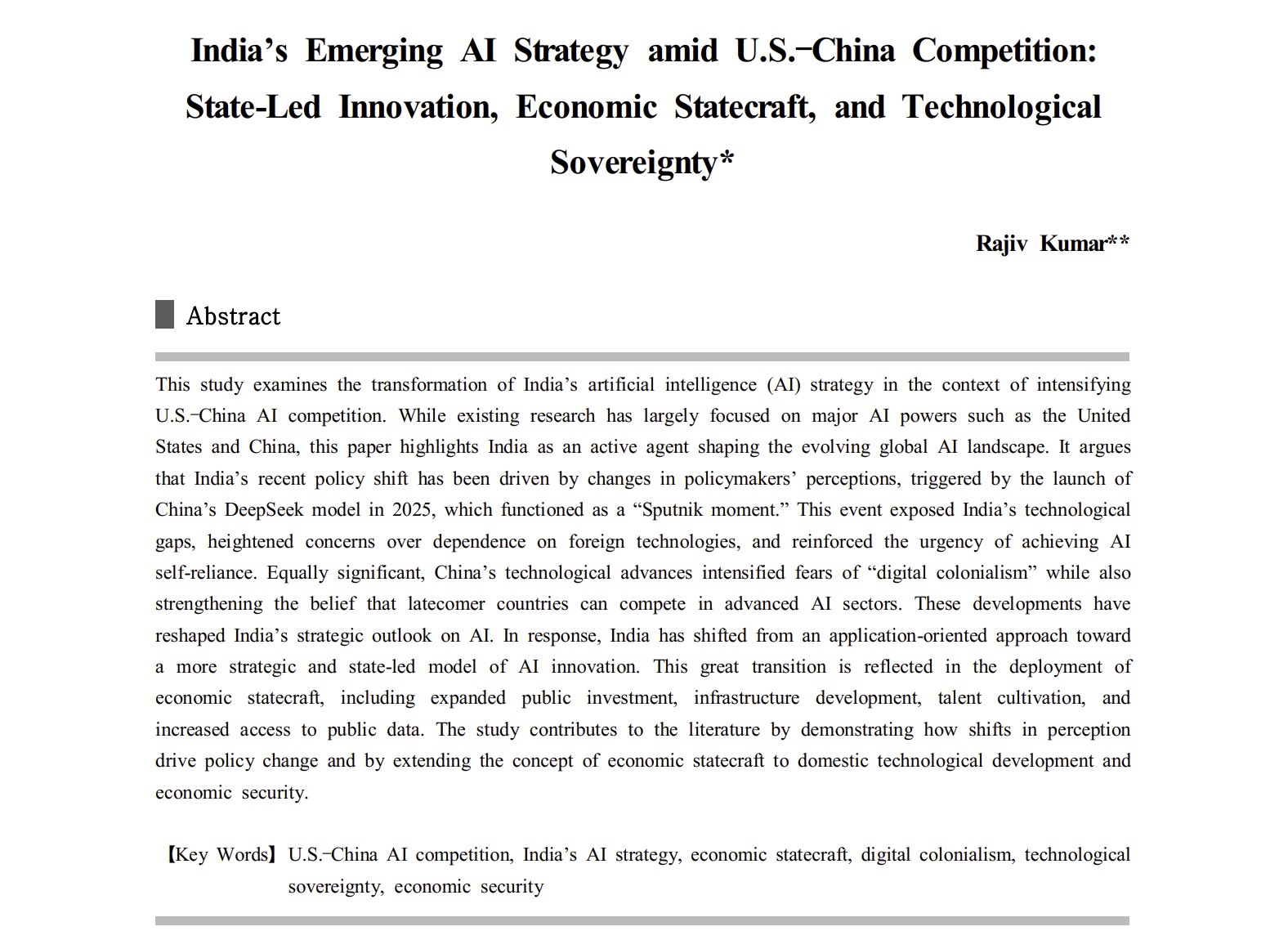
“India’s Emerging AI Strategy amid U.S.–China Competition: State-Led Innovation, Economic Statecraft, and Technological Sovereignty.”
The article examines the transformation of India’s artificial intelligence (AI) strategy in the context of intensifying U.S.–China technological competition. While much of the existing literature focuses on the United States and China, this study highlights India as an active actor shaping the evolving global AI landscape.
The paper argues that India’s recent AI policy shift was influenced by changes in policymakers’ perceptions following the launch of China’s DeepSeek model in 2025, which served as a “Sputnik moment” for India. The emergence of DeepSeek exposed India’s technological vulnerabilities, heightened concerns over dependence on foreign technologies, and reinforced the urgency of achieving AI self-reliance. At the same time, China’s technological advances strengthened both fears of digital colonialism and the belief that latecomer countries can successfully compete in advanced AI sectors.
In response, India has moved beyond an application-oriented approach toward a more strategic and state-led model of AI development. This transformation is reflected in the deployment of economic statecraft through expanded public investment, AI infrastructure development, talent cultivation, and greater access to public data. The study contributes to the literature by demonstrating how shifts in perception drive policy change and by extending the concept of economic statecraft to domestic technological development and economic security.
The India–Korea Forum (IKF) remains committed to producing high-quality research and publications on emerging issues in technology, geopolitics, and international affairs, and to disseminating this research through peer-reviewed international journals and next-generation scholars engagement initiatives.
The article can be downloaded from the Korea Citation Index (KCI) website here: