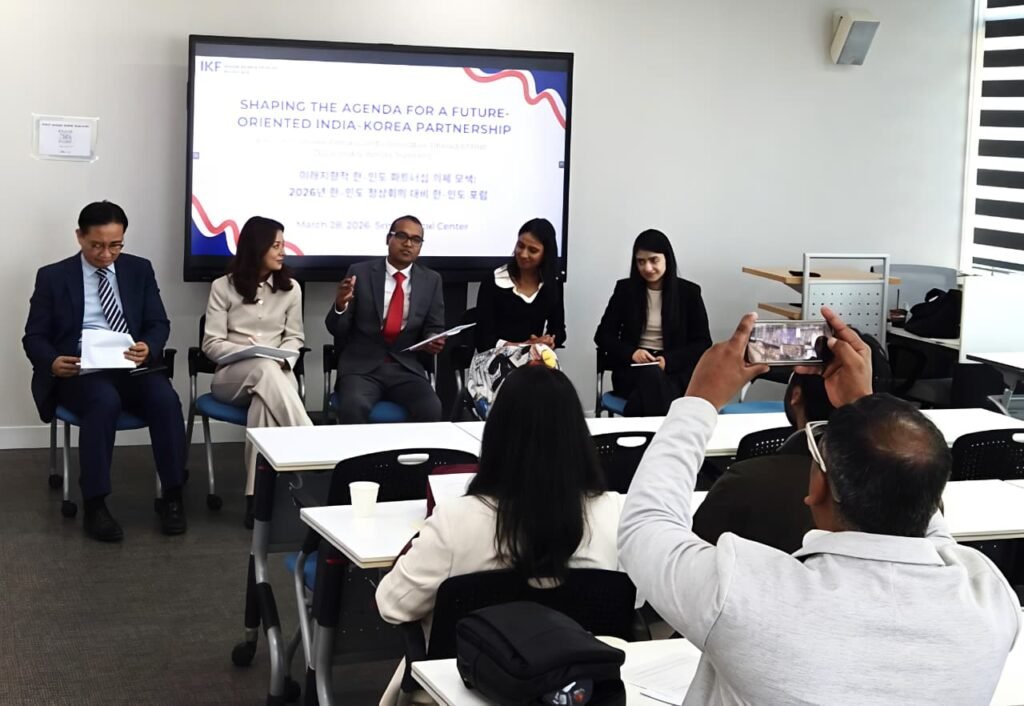



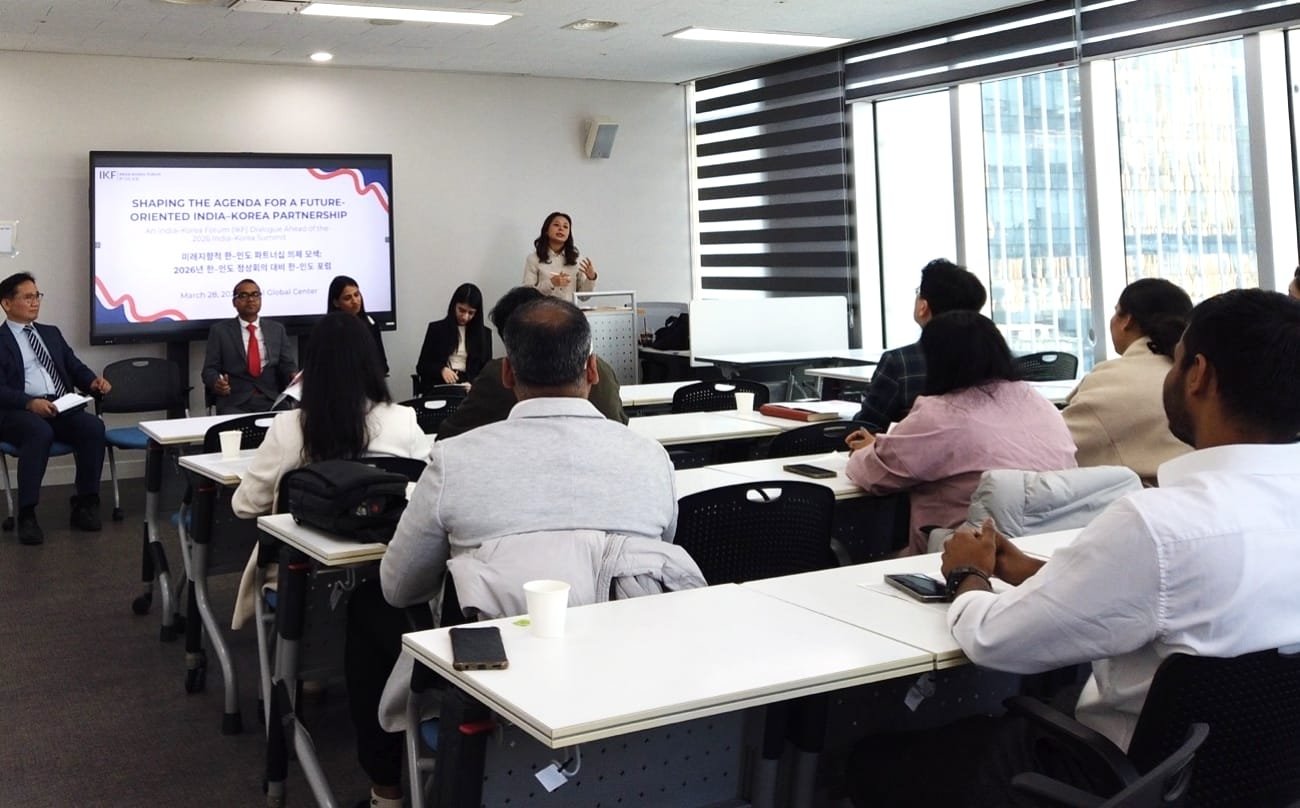
We were pleased to feature Prof. Priyanka Khati, Assistant Professor at Seoul Christian University at the India–Korea Forum 2026 held in Seoul ahead of the upcoming India–Korea Summit.
In her remarks, she provided a clear and practical perspective on the evolving “China+1” strategy and its implications for India–Korea economic cooperation. She emphasized that China+1 is not about companies exiting China entirely, but rather about reducing risk by diversifying production bases. In this context, India is increasingly emerging as a strong alternative, supported by its large domestic market, young workforce, and proactive government initiatives such as Make in India and the Production Linked Incentive (PLI) schemes.
She further explained that South Korea plays a distinct and complementary role in this transformation. Rather than competing in low-cost manufacturing, Korea contributes advanced technological capabilities in sectors such as semiconductors, batteries, and electronics. This creates a natural synergy, where India offers scale and labor, while Korea provides technology, investment, and innovation.
At the same time, she highlighted that while opportunities are significant—particularly in EVs, semiconductors, and green energy—the transition remains gradual. Challenges such as infrastructure gaps, policy constraints, and China’s continued dominance in global supply chains must still be addressed.
Her reflections underscored a critical point:
➡️ The China+1 strategy is not a shift away from China, but a strategic rebalancing—where India and Korea together can play a complementary and increasingly important role.
At a time of global supply chain reconfiguration, strengthening India–Korea collaboration offers a promising pathway toward more resilient and diversified economic partnerships.